pyestimate.pc_ar_estimator
- pyestimate.pc_ar_estimator(x, p, detrend_type='constant')
Principal component AR estimator: estimate the parameters of multiple sinusoids (amplitudes, frequencies and phases). The signal model is \(s[n] = \sum_{i=1}^{p} A_i \cos(2 \pi f_i n + \phi_i)\). This is faster than the MLE estimator implemented in multiple_sin_param_estimate, but less resilient to noise.
- Parameters:
- xarray_like
A 1-D input sequence of real numbers.
- pint
Number of sinusoids to be estimated.
- detrend_type: {‘linear’, ‘constant’}, optional
Specifies how to detrend the input sequence. It is passed as the type argument to the scipy.signal.detrend function. Default to constant.
- Returns:
- A: list of floats
Estimated amplitude of the sinusoids (> 0).
- f: list of floats
Estimated digital frequencies of the sinusoids (or input frequencies if freq was given as input parameter), in ]0, 0.5[.
- phi: list of floats
Estimated phases of the sinusoids, in [-pi, pi].
Notes
This optimator is suboptimal, but practical for a larger number of sinusoids than the MLE estimator implemented in multiple_sin_param_estimate.
References
[1]Kay, S. M. (2013). Fundamentals of statistical signal processing. Volume III, Practical algorithm development. Prentice Hall.
Examples
Generate a sum of noisy sinusoids for which we want to estimate amplitudes, frequencies and phases
>>> from pyestimate.estimators import pc_ar_estimator
>>> import numpy as np
>>> import matplotlib.pyplot as plt
>>> N = 40 # number of samples
>>> f = [0.12345, 0.10345, 0.05234, 0.05, 0.0351] # frequencies to be estimated
>>> A = [1.23456, 1.34567, 1.0, 1.0, 1.0] # amplitude to be estimated
>>> phi = [0.0, np.pi/4, 0.0, 0.0, 0.0] # phase to be estimated
>>> p = len(A) # number of sinusoids
>>> sigma = 0.01 # standard deviation of WGN
>>> n = np.arange(N)
>>> s = 0.0
>>> for i in range(p):
>>>     s += A[i] * np.cos(2*np.pi*f[i]*n+phi[i]) # original signal
>>> w = np.random.default_rng(seed=0).normal(scale=sigma, size=N) # white gaussian noise
>>> x = s+w # input signal for estimation: sine + noise
Estimate sinusoid parameters
>>> A_hat, f_hat, phi_hat = pc_ar_estimator(x, p) # parameters estimation
Reconstruct original signal from estimated parameters
>>> s_hat = 0.0
>>> for i in range(p):
>>>     s_hat += A_hat[i] * np.cos(2*np.pi*f_hat[i]*n+phi_hat[i]) # estimated signal
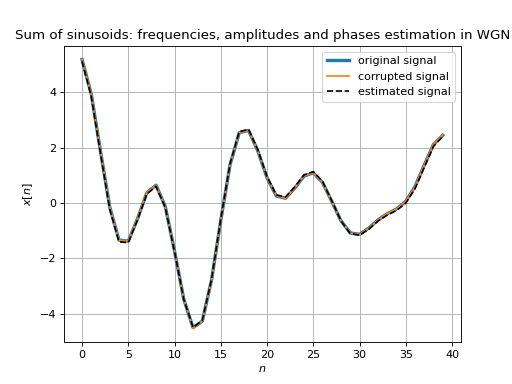
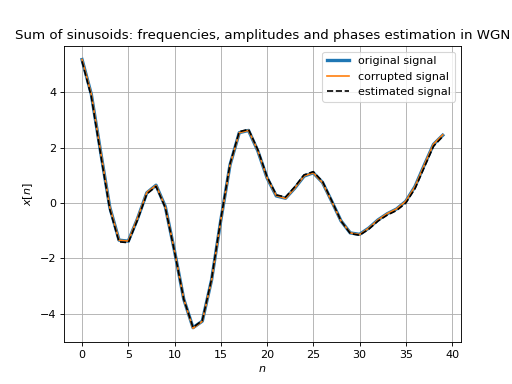
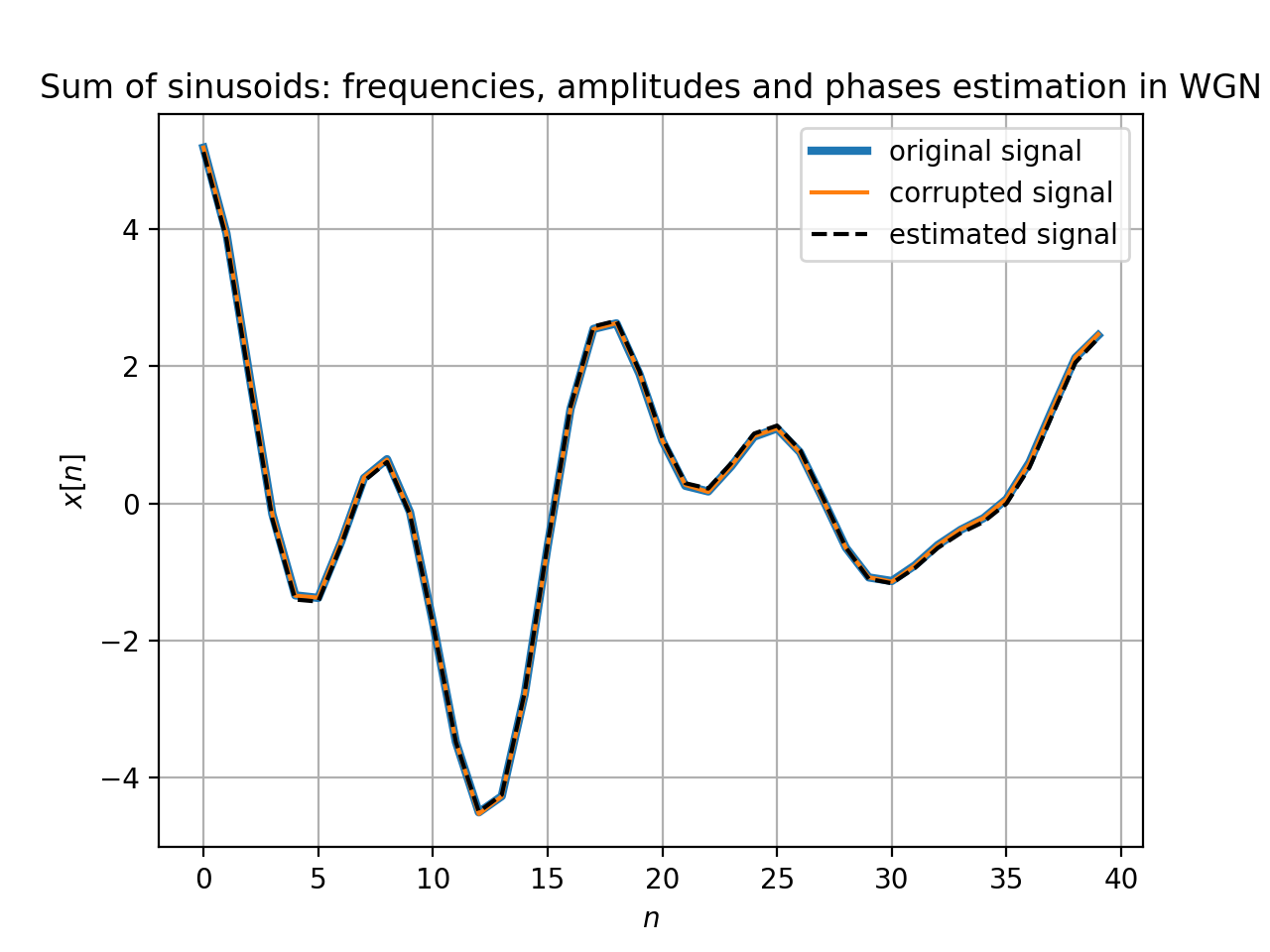
Plot the original signal, the input signal corrupted with noise and the reconstructed signal
>>> plt.plot(n, s, linewidth=3.0, label='original signal')
>>> plt.plot(n, x, label='corrupted signal')
>>> plt.plot(n, s_hat, 'k--', label='estimated signal')
>>> plt.xlabel('$n$')
>>> plt.ylabel('$x[n]$')
>>> plt.title('Sum of sinusoids: frequencies, amplitudes and phases estimation in WGN')
>>> plt.legend()
>>> plt.grid()
>>> plt.show()
(
Source code,png,hires.png,pdf)